Iodised Salt vs Table Salt: What's the Difference?
12 August 2026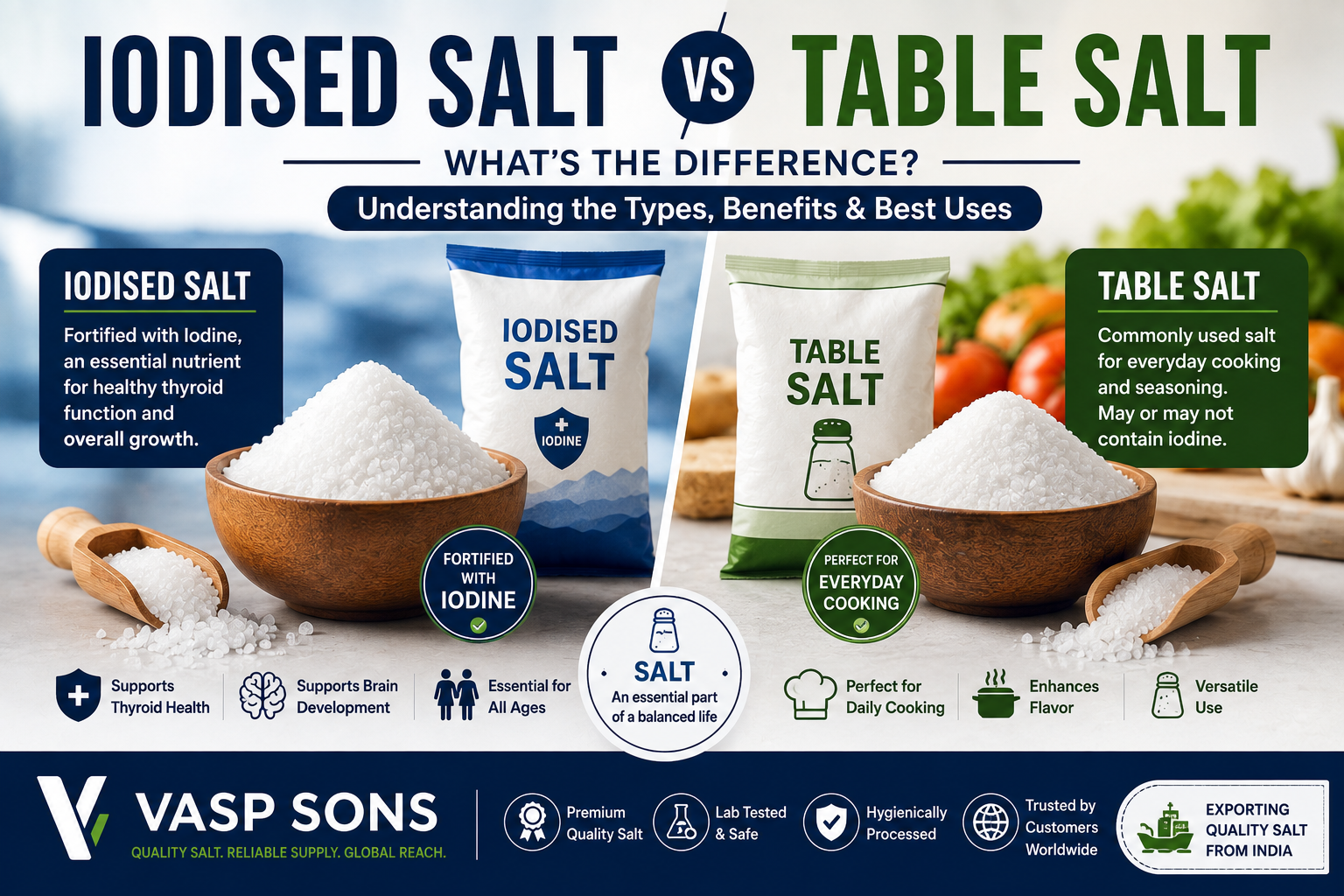
But when you look at different salt products, you may come across terms such as iodised salt, table salt, edible salt, refined salt and common salt.
This raises an important question:
Is iodised salt different from table salt?
The answer is: they are not necessarily two completely different types of salt.
Table salt generally describes salt intended for use at the table or in everyday cooking, while iodised salt describes salt that has been fortified with iodine.
In other words, table salt can be iodised salt.
Let's understand the difference in detail.
What Is Table Salt?
Table salt is edible salt commonly used for everyday cooking and seasoning.
It is typically processed to achieve a relatively consistent crystal size and clean appearance. Depending on the market and product specification, table salt may be available in different crystal sizes, from fine to coarser grades.
Table salt can be used for:
Home cooking
Food preparation
Seasoning
Restaurants
Food processing
Retail packaging
Food manufacturing
For commercial buyers, the term table salt alone is not enough to define the product.
A buyer should also specify parameters such as:
Sodium chloride (NaCl) purity
Moisture
Insoluble matter
Crystal size
Particle Size Distribution (PSD)
Iodine requirement
Packaging
Food-safety requirements
This becomes particularly important when purchasing table salt internationally.
What Is Iodised Salt?
Iodised salt is edible salt to which iodine has been added in a controlled quantity.
Iodine is an essential mineral required by the human body to produce thyroid hormones. These hormones are important for metabolism and also play important roles in growth and brain development.
Because salt is consumed regularly and in relatively consistent quantities, it is an effective vehicle for delivering iodine through the diet. FSSAI also explains that iodine can be added to common edible salt without significantly changing its appearance, smell or taste.
So the easiest way to understand the terminology is:
Table salt = describes the use/form of the salt.
Iodised salt = describes the addition of iodine to the salt.
Therefore, a product can be both table salt and iodised salt.
Iodised Salt vs Table Salt: The Key Difference
The biggest distinction is iodine fortification.
Feature | Iodised Salt | Table Salt |
|---|---|---|
Intended for human consumption | Yes | Yes |
Used for cooking | Yes | Yes |
Used for seasoning | Yes | Yes |
Contains added iodine | Yes | May or may not |
Available in different crystal sizes | Yes | Yes |
Can be packaged for retail | Yes | Yes |
Requires specification for commercial purchase | Yes | Yes |
The important point is that "table salt" does not automatically tell you whether the salt is iodised.
If iodine is important for your market, application or regulatory requirement, you should specifically request iodised salt and confirm the iodine specification.
Why Is Iodine Added to Salt?
Iodine is needed to produce thyroid hormones. Adequate iodine is especially important during pregnancy and infancy because thyroid hormones contribute to normal brain and bone development.
Iodised salt provides a practical way of increasing iodine intake because salt is widely consumed.
This is one reason iodisation has become an important public-health measure in many countries.
In India, FSSAI's guidance states that common salt for direct human consumption or use as an ingredient in food is required to be iodised, subject to specified exemptions.
Is All Table Salt Iodised?
No—not necessarily.
The word table salt primarily describes the intended culinary use of the product. Whether it contains iodine depends on the product, country, regulations and label.
For example, specialty salts such as some sea salts, kosher salts and Himalayan salts are often not iodised unless specifically fortified.
Therefore, buyers should never assume that a salt is iodised simply because it is labelled as table salt.
Always check the specification or product label.
For international buyers, this is particularly important because salt regulations and iodine requirements can differ between countries.
Is Iodised Salt Better Than Non-Iodised Table Salt?
For populations where iodine intake may be inadequate, iodised salt provides the additional nutritional benefit of iodine.
However, this does not mean that people should consume more salt.
The important distinction is:
Iodisation adds iodine; it does not make salt a low-sodium food.
Salt should still be consumed in moderation as part of a balanced diet.
For individuals with specific medical or dietary requirements, the appropriate salt and iodine intake should be discussed with a qualified healthcare professional.
Does Iodised Salt Taste Different?
A common concern is that adding iodine might significantly change the taste of salt.
In practice, iodisation is designed to add iodine in a very small quantity, and FSSAI notes that the addition does not significantly affect the appearance, smell or taste of edible salt.
This means iodised salt can be used in everyday cooking just like ordinary table salt.
What Should Salt Importers Check When Buying Iodised Salt?
For international buyers, the difference between iodised salt and table salt is more than a simple question of terminology.
A professional buyer should define the product specification clearly.
1. NaCl Purity
Ask the exporter for the required sodium chloride purity.
2. Iodine Specification
Specify whether the product must be iodised and what iodine level is required according to the destination market.
3. Moisture
Excessive moisture can affect handling, storage and product performance.
4. Insoluble Matter
This is an important quality parameter for edible salt.
5. Crystal Size
Do you need:
Fine salt?
Medium salt?
Coarse salt?
Don't simply tell your supplier:
"I need good-quality table salt."
Instead, provide the required crystal size or PSD (Particle Size Distribution).
6. Packaging
Specify whether you require:
500 g packs
1 kg packs
5 kg packs
25 kg bags
50 kg bags
Bulk packaging
Private-label packaging
7. Certificate of Analysis
Request a COA that corresponds to the product being supplied.
Why PSD Matters in Table Salt
One area that is often overlooked by buyers is Particle Size Distribution (PSD).
Two suppliers can both offer "table salt," but their products may behave differently because their crystal sizes are different.
For example, a food manufacturer may require a particular salt size for:
Faster dissolution
Uniform mixing
Seasoning
Food processing
Automated filling
Specific product formulations
Therefore, when purchasing table salt, don't stop at the product name.
Specify the physical characteristics you actually need.
This is particularly important for bulk international shipments.
Iodised Salt and Storage
Iodised salt requires appropriate storage and packaging because iodine can be lost over time under certain conditions.
FSSAI advises storing iodised and other fortified salt in closed, airtight containers away from direct sunlight and moisture. It also notes that inadequate packaging during transportation can contribute to iodine loss.
For exporters and importers, this means:
Good salt quality + good packaging + proper storage = better product protection throughout the supply chain.
Iodised Salt for Food Manufacturers
Food manufacturers often purchase salt in much larger quantities than household consumers.
For them, the right product may depend on the application.
A manufacturer may specify:
Iodised or non-iodised requirement
NaCl purity
Moisture
Insoluble matter
PSD
Packaging
Delivery quantity
Batch consistency
Food-safety documentation
This is why a good salt supplier should ask questions about the buyer's application rather than simply quoting a price per metric ton.
Iodised Salt for International Buyers
If you are importing iodised salt from India, don't rely only on the supplier's standard specification.
Tell the exporter:
"This is my destination country. This is my application. This is my required specification."
The exporter can then determine whether the available product meets your requirements.
This is especially important because the food regulations, labelling requirements and iodine specifications applicable in one market may not be identical to those in another.
How VASP SONS Approaches Iodised Salt and Table Salt
At VASP SONS, we understand that different buyers have different requirements.
An importer purchasing iodised salt may need a specific iodine specification.
A distributor purchasing table salt may be more concerned about crystal size, packaging and retail presentation.
A food manufacturer may prioritise purity, PSD, consistency and technical specifications.
Therefore, our approach is to understand the buyer's requirement first and then discuss the appropriate salt specification.
At VASP SONS, our focus includes:
Quality-focused salt supply
Iodised salt
Table salt
Different crystal sizes
Bulk supply
Export packaging
Buyer-specific requirements
Consistent product specifications
International customer support
Our objective is not simply to sell a bag of salt.
Our objective is to supply the salt specification that fits the buyer's requirement.
Iodised Salt vs Table Salt: Which One Should You Choose?
The answer depends on what you mean by "table salt."
If you are looking for salt for everyday cooking and want iodine fortification, iodised table salt can meet both descriptions.
If you are purchasing salt commercially, however, you should be more specific.
Instead of saying:
"I need table salt."
Tell your supplier:
"I need food-grade iodised salt with ___% NaCl purity, ___ iodine specification, ___ crystal size, ___ moisture, packed in ___ kg bags."
This makes your purchasing requirement much clearer.